Category Archives: General discussion

Anything else.

The Godwinator

Fig.1: Obamacare analogy

George Will, whose pseudo-logical musings at the Washington Post inspired our work here so many years ago, has moved from ABC to Fox News.  In keeping with the tone of his new employer, he waxes historical about the legality of Obamacare (via Talking Points Memo):

In an interview with NPR’s “Morning Edition,” host Steve Inskeep asked Will about President Barack Obama’s argument that Republicans are short-circuiting the system by using government funding and the debt ceiling as leverage to dismantle Obamacare, rather than repealing the law outright.

“How does this short-circuit the system?” Will said. “I hear Democrats say, ‘The Affordable Care Act is the law,’ as though we’re supposed to genuflect at that sunburst of insight and move on. Well, the Fugitive Slave Act was the law, separate but equal was the law, lots of things are the law and then we change them.”

Many here are familiar with Godwin’s law, where as a discussion grows longer, the probability of a Hitler analogy approaches 1.  We might now offer two variations on that.  Given any possible disagreement, the probability of a completely inept Hitler is initially 1.  The second variation is implied in the first: Hitler is a mere stylistic choice: the invoker can select any other moral abomination according to need.

One further rule: some iron-manner will come to the defense of the Godwinator:

I generally agree with TPM, but this headline is an outrageous distortion of what GW said.

His view is that Obamacare law is wrong, which is a legitimate view (not  mine).  He then points out that we have rescinded laws that we all regard as wrong.  He was speaking to the process, not the content.

Nah.  That isn’t his view and this ignores the inappropriate analogy.  Looking past these kinds of rhetorical outrages keeps them alive.

I’m already plenty good at logic

Charles S. Peirce opens the “Fixation of Belief” with the observation:

Few persons care to study logic, because everybody conceives himself to be proficient enough in the art of reasoning already.

Many of the NS readers are familiar with the Dunning-Kruger effect.  In short, it’s that the less you know, the less likely you’ll recognize that you don’t know.  Poor performers regularly overestimate their abilities.  This is borne out in Dunning and Kruger’s case in grammar tests, logic tests, humor-recognition tests and in a variety of other areas (e.g., tests taken by medical students, engineers, and so on).   The trouble is that self-monitoring can’t give reliable feedback when you don’t have the proper criteria for evaluation.

So the question is: how do people perform when, after having done badly and evaluated themselves well, we give them clear criteria for evaluation?  How do they do, and how do they rate their performances? For sure, without this intervention, the D-K Effect becomes the D-K Cycle.  But can intervention as education work?

So after having bombed the last logic test, the subjects are brought back in and given a mini-lecture on how to solve the logic problems they were tested on last time.  They, then, had the criteria for discriminating good from bad performances. The result?  They judged their prior performances quite harshly and came to see that they had a long way to go before they were good at the tasks.  That’s pretty great news to logic teachers.

Ah, but an interesting wrinkle about the need for this intervention.  Dunning and Kreuger gave the same test to two different groups, but told one group it was a logic test and the other group that it was a computer-test.  Here’s the big difference:  people who took the logic test systematically more confident (and thereby overrated themselves in poor performances) than those who took the computer test.  Same test, but different name.  Why is this?  The thought is that it’s because we all think we’re already pretty good at reasoning.  We do it every day, so we must have some skills.  And it’s right there that logic teachers cringe.


Salarywoman

Fig 1: hypocrite

As we’ve argued here many times before, not all charges of hypocrisy are logically vicious.  Someone’s hypocrisy might be evidence that her view is too difficult to enact (like Newt Gingrich’s conception of traditional marriage) or, more importantly, that she’s logically incompetent.  Here is an example (from Talking Points Memo):

Rep. Renee Ellmers (R-NC) told a local television station that she would not be deferring her pay during the government shutdown, as some other members have done.

“I need my paycheck. That’s the bottom line,” Ellmers told WTVD in Raleigh, N.C. “I understand that there may be some other members who are deferring their paychecks, and I think that’s admirable. I’m not in that position.”

According to Ellmers’s official website, she was a registered nurse for 21 years before being elected to Congress. Her husband Brent, the website says, is a general surgeon.

Democratic Rep. G.K. Butterfield also told WTVD that he wouldn’t be deferring his pay. “I don’t think there should be a shutdown,” he said. “I didn’t create the shutdown.”

The other federal employees–some of whom continue to work–also need their paychecks.  That you cannot sustain the very thing you advocate is evidence that the thing you advocate is unsustainable.

Dumb and dumber

The other day I linked to an article about an unfortunate consequence uncovered by some research in cognitive psychology: some argumentation, however good (conclusive or decisive), reinforces the ignorance of the person who is wrong.  Arguing with someone who is wrong, but steadfast in her wrongness, just makes everything worse.

This Onion article makes a related, and equally chilling point:

SEATTLE—As debate continues in Washington over the funding of President Obama’s health care initiative, sources confirmed Thursday that 39-year-old Daniel Seaver, a man who understands a total of 8 percent of the Affordable Care Act, offered a vehement defense of the legislation to 41-year-old Alex Crawford, who understands 5 percent of it.

The conclusion:

“Hold on, Alex, let’s go back to the premiums for a second, because I feel like I need to drive this point home for you: they’ll get lower for most people,” said Seaver, straining the very limits of his 8 percent comprehension of the bill to the point of utter collapse. “Lower premiums, lower deductibles, and no denial of coverage to people with preexisting conditions.”

“Way lower premiums,” Seaver added.

At press time, both men’s understanding of Obamacare had dropped to 3 percent as a result of the debate.

I think this problem is undertheorized, but then again I don’t really know this literature.

When argument doesn’t work, try argument

Fig 1: arguing badly by going for the jugular

Courtesy of a former student, here’s an interesting read from Pacific Standard about the effectiveness of counter arguments and contrary information on people’s attitudes towards their own beliefs.  TL;DR: counter information makes people more likely to persist in their false beliefs:

Research by Nyhan and Reifler on what they’ve termed the “backfire effect” also suggests that the more a piece of information lowers self-worth, the less likely it is to have the desired impact. Specifically, they have found that when people are presented with corrective information that runs counter to their ideology, those who most strongly identify with the ideology will intensify their incorrect beliefs.

When conservatives read that the CBO claimed the Bush tax cuts did not increase government revenue, for example, they became more likely to believe that the tax cuts had indeed increased revenue (PDF).

In another study by Nyhan, Reifler, and Peter Ubel, politically knowledgeable Sarah Palin supporters became more likely to believe that death panels were real when they were presented with information demonstrating that death panels were a myth. The researchers’ favored explanation is that the information is so threatening it causes people to create counterarguments, even to the point that they overcompensate and become more convinced of their original view. The overall story is the same as in the self-affirmation research: When information presents a greater threat, it’s less likely to have an impact.

This naturally raises the question: are we doomed?  Part of the problem, I think, is that people generally argue very badly.  This is part of the point of Scott and Rob’s book: Why We Argue.  See here for a post the other day.  Take a look, for instance, at the following claim:

This plays out over and over in politics. The arguments that are most threatening to opponents are viewed as the strongest and cited most often. Liberals are baby-killers while conservatives won’t let women control their own body. Gun control is against the constitution, but a lack of gun control leads to innocent deaths. Each argument is game-set-match for those already partial to it, but too threatening to those who aren’t. We argue like boxers wildly throwing powerful haymakers that have no chance of landing. What if instead we threw carefully planned jabs that were weaker but stood a good chance of connecting?

I don’t have any issues with this advice.  Indeed, I think it does not show that argument of the basic logical variety we endorse here doesn’t work.  On the contrary, it works really well; this is just how you do it.

To rephrase the author’s advice: you’ve been arguing badly all along.  Constantly going for the knock out argument is a bad strategy primarily because it’s bad argumentation.  Such moves are very likely to distort the views of the person you’re trying to convince and in so doing alienate them.  What’s better is the slow accumulation of evidence and the careful demonstration of the truth or acceptability of your beliefs.

“Whoever is not for us is against us” is not a logical principle

Fig 1: opponents of book learning

A handful of Christian Conservatives in Kansas want to stand in the way of uniform standards for science education.  Their argument, as reported by the AP:

The lawsuit argues that the new standards will cause Kansas public schools to promote a “non-theistic religious worldview” by allowing only “materialistic” or “atheistic” explanations to scientific questions, particularly about the origins of life and the universe. The suit further argues that state would be “indoctrinating” impressionable students in violation of the First Amendment to the U.S. Constitution’s protections for religious freedom.

Apt commentary from an opponent of this kind of idiocy:

“They’re trying to say anything that’s not promoting their religion is promoting some other religion,” Rosenau said, dismissing the argument as “silly.”

It’s hard to improve on this remark, maybe: “whoever is not for us is against us” is not a principle of logic.

via Reddit and Forward Progressives.

Popular Science positively starves the trolls

Popular Science has completely shut off comments for their articles, citing trolling at their number one reason.  Given our interest here at the NS in the don’t feed the trolls maxim and our fixation on the Iron Man Fallacy, it’s worth a shot thinking this through.  I’ve got a defense of the decision over at WWA, especially against the Will Oremus charge that it’s a form of scientific dogmatism (or as he says: “Lazy and Wrong“).

See my post at WWA.  HERE.

Why We Argue Blog

wwa

My new book with Robert Talisse is Why We Argue (And How We Should).  It’s got a lot of the discussions you’ve seen here at the NS.  Our agreement with the publisher is that we keep a blog with substantive entries on argumentation and politics up and running for a few years.  So here’s my plan. I’ll still do short blogging here at the NS, but longer essay-type entries will be over at the WWA site.  I’ll have pointers here for the WWA articles and I’ll have pointers there for the NS articles.  For fans of the NS, the book will be some familiar territory, but some other new stuff – especially the requirements of good reasoning to keep Plato’s worries about democracy at bay.  You can find the WWA blog here.  And you can buy a copy of WWA here.

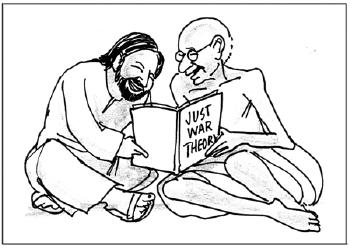
Jus ad argumentum

Classical just war theory’s jus ad bellum requirement of proportionality means that not every offense requires war.  There is an analogy to argument here, however imperfect: not every disagreement, moral or factual, requires that we argue.  I may be right about x, but I don’t have to argue with you about it.  This is especially the case when I will never convince you.

I think this capture’s the spirit of the Summus Pontifex’s recent remarks on the value of pushing the Catholic positions on abortion, contraception, and gay marriage.  Perhaps the Holy Father has noticed that, though the Universal Church’s view on gay marriage contains no admixture of error, the likelihood of its success with this argumentation is very low and the costs are very great:

“We cannot insist only on issues related to abortion, gay marriage and the use of contraceptive methods. This is not possible. I have not spoken much about these things, and I was reprimanded for that. But when we speak about these issues, we have to talk about them in a context. The teaching of the church, for that matter, is clear and I am a son of the church, but it is not necessary to talk about these issues all the time.

“The dogmatic and moral teachings of the church are not all equivalent.The church’s pastoral ministry cannot be obsessed with the transmission of a disjointed multitude of doctrines to be imposed insistently.Proclamation in a missionary style focuses on the essentials, on the necessary things: this is also what fascinates and attracts more, what makes the heart burn, as it did for the disciples at Emmaus. We have to find a new balance; otherwise even the moral edifice of the church is likely to fall like a house of cards, losing the freshness and fragrance of the Gospel. The proposal of the Gospel must be more simple, profound, radiant. It is from this proposition that the moral consequences then flow.

This is not terribly unreasonable.  This is made somewhat easier by the fact that I don’t share any of his views.  Nonetheless, I have a lot of opinions that just do not deserve arguments–not the least because (1) I can only expect so much time, attention, and effort from people who disagree with me; (2) I only have so much time and energy to devote to convincing other people.  We expend resources when we argue; we ought to use them judiciously.

So it’s surprising to me to see behavior like this:

Providence College, a Roman Catholic school in Rhode Island, has canceled a lecture in support of same-sex marriage on Thursday by a gay philosophy professor, citing a church document that says that “Catholic institutions should not honor those who act in defiance of our fundamental moral principles.”

You get the idea from the Pope that they’re not that fundamental.  But in any case, the College has reversed itself, thankfully.

via Leiter.

My Godwin-Sense was tingling

CRUZ Budget_Battle-0a51e

In Godwin’s Law news (and another instantiation of the Ad TyrranemAd Hitlerem), Ted Cruz’s recent Senate speech has a classic:

I suspect those same pundits who say [defunding Obamacare] can’t be done, if it had been in the 1940s we would have been listening to them. . . .They would have been saying, ‘You cannot defeat the Germans

In this case, it’s not an argument that what’s being opposed is wrong, but that not actively opposing the thing is wrong.  I think, then we have two different forms of the ad Hitlerem.

Direct Ad Hitlerem:

You do X or propose X

Hitler did X or proposed X

Therefore, you’re like Hitler and X is wrong.

Here, I  think Cruz is making an indirect form of Ad Hitlerem.  It runs roughly:

He does X (and X is wrong)

We can stop him from doing X

His doing X is like Hitler’s doing Y

Therefore, he’s not only wrong to do X, but we’re wrong (read: appeasers) to not actively oppose and stop his doing X.

My view about Ad Hitlerem is that it’s a weak analogy, and that’s the case for both direct and indirect.  A further thing about the indirect form is that it depends on the direct form.  Essentially: This guy is like Hitler , so this guy is bad (Direct form); If you can stop a guy who’s bad like Hitler, you should as to fail to do so is appeasement (Indirect form).