Alternate facts

Boing Boing’s Facebook page shared a Little Golden Book parody mocking Conway’s use of “alternative facts.”

By now, we’re all familiar with Trump Adviser KellyAnne Conway’s remark about “alternate facts.” If not, a brief summary:

The outrage over “alternative facts” began Sunday, when Conway appeared on “Meet the Press” and defended press secretary Sean Spicer’s inaccurate statement about the size of inauguration crowds.

“Sean Spicer, our press secretary, gave alternative facts,” Conway said.

“Wait a minute,” host Chuck Todd countered. “Alternative facts? … Four of the five facts he uttered were just not true. Alternative facts are not facts. They are falsehoods.”

That has led to all sorts of internet hilarity (my favorite is the picture above). More on this in a second.

Sadly, however, this is an instance in which it’s clear that Conway means or should mean “rebutting facts” or “challenges to those facts.” To be precise, we probably should be talking about “alleged” facts in this case, or better, “claims.” A little charity and precision, in other words, would do much to clarify the matter.

Once we settle this common language problem, we can determine who is more likely to be right about this (not them). This is really what we ought to be focused on anyway (although, this particular question seems completely pointless). We’ve got, after all, a well-established way of settling these things. It’s not great, but it’s well-established.

This raises a question, however, as to whether this choice of term (“alternate facts”) is just the point.  This “alternate facts” stuff sure provokes a lot of laughter from logic types like yours truly. And perhaps this is just the point.  Sad.

A weary ad hominem

It’s an old trope to cast feminists as ugly.  The following inference seems to be either a direct ad hominem or a kind of debunking strategy on their claims.  The direct ad hominem runs as follows:

S is ugly

Therefore, the things S says aren’t worth our time

Notice that the direct argument has application to anyone, regardless of gender or politics.  The debunking argument works as a kind of explanation for the things S says — essentially, that they don’t track truths, but are mere expressions of resentment. The debunking argument, importantly, is uniquely targeting women who are feminists.

S is an ugly woman

Ugly woman have little chance with men

This causes them to be resentful

Out of resentment, they emote using terms like ‘patriarchy’ and ‘misogyny’.

Therefore, the things S says amount to mere emoting

The first form is a pretty clear error in relevance, the second is actually an instance of exactly the kind of sexist attitudes S’s feminism was criticizing.   But, hey, so it goes for those who rely on the ad hominem for their argumentative strategies — they hardly recognize when their use of it exemplifies precisely what the problem challenged is.   It seems to be in higher relief, though, with these cases applied to feminists.

Enter James Delingpole, over at Breitbart.  In some ways, I expect he’s just trolling (it’s a modified version of Poe’s Law — with right wing pigeons, you can’t tell whether they are serious, someone else lampooning them, or them embracing their worst sides just to get a rise out of you).  But, if the Poe point is right, who knows? In response to the Women’s Marches this last Sunday, he tweets:

Sheesh.  That’s just silly. Not just because folks were coming from well beyond DC. But here’s where things get bad, because Delingpole follows up the tweet with his article, and he puts a little edge on the issue.  Ad hominem edge, that is.

But this is self-evidently impossible. Very few of these shrieking munters – save the token celebrities – will ever find themselves in a position where they are able to fetch a man’s beer from his fridge because first they would have to find a man willing to share the same space with them.

Yep.  That’s what he wrote.  And the lesson he takes from it is that these folks are representative of what a Clinton Presidency would have looked like.

I think we owe those women who took to the streets across the world in their various pod groups a massive favour. They have reminded us what a Hillary presidency would have looked like every single day for at least four years.

Again, what’s it look like?

… the usual ragbag of leftist suspects, far too many of them blue hair, their whale-like physiques and terrifying camel-toes the size of the Grand Canyon.

Holy crap.  Let me take a breath here.  Does Breitbart have an editor over there?

The point I want to highlight how the use of one version of the ad hominem on feminists is a perfect picture of exactly the problem that feminists are out to address.  I think the only way someone could make this error so consistently is unless either (a) the person is trollling and is doing it intentionally for the sake of irritating a political opponent, (b) the person really doesn’t hear the critique as a critique, but, per the argument, just as empty emoting.  Either way, it’s an argumentative failure.  But, perhaps more importantly, a moral one, too.

I very strongly assert

Sean Spicer’s first press conference was pretty firey.  The most eye-catching part of it was his argument that Trump’s inauguration had the highest attendance ever.

That was the largest audience to witness an inauguration, period.

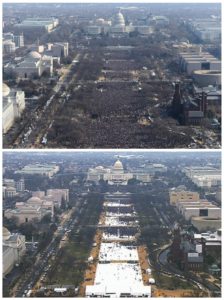
His was a pretty complex argument.  There were two lines of reasoning. The first, to rebut the claims that the photographic evidence shows attendance to be significantly lower than Obama’s ’09.  The second, to make the case for a very large number.  The largest number, period.

The rebutting argument was that the photo doesn’t accurately represent attendance, because the mall wasn’t the place where all the people were (because of fencing, metal detectors, etc.) and because the materials on the ground make the open spaces look larger.

This pair of photos shows a view of the crowd on the National Mall at the inaugurations of President Barack Obama, above, on Jan. 20, 2009, and President Donald Trump, below, on Jan. 20, 2017. The photo above and the screengrab from video below were both shot shortly before noon from the top of the Washington Monument. (AP Photo) NYAJ501

The positive argument was that the spaces filled during the inauguration added up to a very large number.

We do know a few things. So let’s go through the facts. We know that from the platform from where the President was sworn in to 4th Street holds about 250,000 people. From 4th Street to the media tent is about another 220,000. And from the media tent to the Washington Monument another 250,000 people. All of this space was full when the President took the oath of office.

So that’s about 720K.  (Trump claimed it was 1.5 million, when he was at the CIA office, later.)

But here’s the thing.  Estimated attendance at Obama’s ’09 was 1.8 million.  So, even were Spicer’s rebutting argument accurate and his positive argument correct, that’s not even half of Obama’s ’09 number.  It’s not even the 1 million estimated for Obama’s ’13.

There were three arguments Spicer needed to make here, and he only made two of them.  The comparative argument for the superlative (period) needed to be made, too.  And no fudging with gates and ground covering would have fixed that one.


Polarization Perfectionism

Hi all, I’m back blogging here at the NS again, after a long break.  Ready to get back to it.  Thanks, John, for keeping the fire burning.

David French, over at National Review, has some pretty dark views about whether the partisan divide will ever be bridged, given the polarization of the political populace.  He makes some nice observations that polarization yields the view that one’s opposition is less open-minded, intelligent, honest, or even hard working than the average American.  (He leaves out the fact that polarization is both the result and cause of the divide, which is that it’s too often that we only talk to and read our own side…).

His argument that we can’t overcome polarization is on the basis of what he sees as who would need to be the leader for it. Namely, the new president, Mr. Trump.  The Donald has alienated folks given the way he’s campaigned (and given the inaugural), so folks don’t trust him.  But even if he were to soften his tone and recognized his political opponents as more than craven losers, French doesn’t think it’d make things better.

…if Trump stopped tweeting, spoke only in the most measured tones, and relentlessly reached out to black and Latino voters while also governing as a conservative, many millions of leftists and their media supporters would still howl in fury at his political program. You would relentlessly hear that Trump was somehow worse now than when he insulted his opponents, because that was only talk, while his policies represent actions.
This is a case of what’s sometimes called the Perfectionist false dilemma.  The reasoning goes like this:
We can either adopt some change to improve things or leave things as they (unfortunately) are.  The change won’t fix everything, nor would any fix be quick.  Therefore, the fix isn’t worth it.
Of course, the conclusion does not follow when it’s put that way.  Why? Because the reasoning leaves out the tertium quid of the ameliorating option of making things a little less bad.  Sure, in the Trump case, people still would distrust him and oppose him.  But that’s likely because of his long and bad history, and moreover, if he (as French notes) doesn’t change  his policies, he would merely be play-acting.  (Sure, if you only change your rhetoric, that’s not going to improve the divide by anything…)
But the main issue would be: if T were to change the rhetoric and actually heard the voices of those who were critical, then there may be some policy shift.  That would help with polarization.  Moreover, if he would take the time to explain his policies to those who disagree, maybe we’d understand why what he’s doing is more than sheer keptocratic manipulation.  But, hey, he’s just the President, not a miracle-worker, right?

The Ring of Gyges

Image result for gyges greek mythology

For many years now, I’ve used the anonymity of internet comments as an example of the Ring of Gyges in the first book of Plato’s Republic. No doubt you’re familiar with the idea: given a ring of invisibility, would you be a jerk or not? The internet sometimes grants a kind of anonymity with regard to dialectical exchanges on the internet. If you don’t have to reveal who you are, will you write the uninhibited comment rich with all manner of ad hominem? The thought was that lots of people would.

Well, it turns out this thought was probably wrong. Research seems to indicate that internet anonymity does not contribute to debased debates. It’s (partially) something much more satisfying (to me): lack of regulation:

Clear social norms can reduce problems even when people’s names and other identifying information aren’t visible. Social norms are our beliefs about what other people think is acceptable, and norms aren’t de-activated by anonymity. We learn them by observing other people’s behavior and being told what’s expected [2]. Earlier this year, I supported a 14-million-subscriber pseudonymous community to test the effect of rule-postings on newcomer behavior. In preliminary results, we found that posting the rules to the top of a discussion caused first-time commenters to follow the rules 7 percentage points more often on average, from 75% to 82%.

This is somewhat heartening, I think. It holds out hope that people can channel their energies more productively in clearly regulated environments, like this one (so, no ad hominems, jerks).

Fallacy theory and democracy

Instead of writing something myself today, I thought I’d post a link to this interesting piece by Scott Aikin and Robert Talisse on Democracy and the Owl of Minerva Problem. A critical graph:

We argue in our natural languages, and so often when we argue, we argue over economies, animals, environments, poverty, and so on. But arguments are structured collections of statements that are alleged to manifest certain kinds of logical relations; consequently, they, too, can be the subject of scrutiny and disagreement. And often in order to evaluate a claim about, say, poverty, we need to attend specifically to the argument alleged to support it. In order to discuss arguments, as arguments, we must develop a language about the argumentative use of language. That is, we must develop a metalanguage. The objective in developing a metalanguage about argument is to enable us to talk about a given argument’s quality without taking a side in the debate over the truth of its conclusion.

The critical idea is that our theory about deliberative debate always follows the debate itself. This explains our ill-preparedness for what these debates offer. See: 2016.

No fair!

Scott and I wrote a piece for an anthology of fallacies (I think the title is still up in the air). One of our contributions was on the straw man (of course!), the other was on the “Free Speech Fallacy.” Here is how we defined it:

The fallacy arises when a contributor to a critical exchange confuses the protected freedom of expressing an opinion with correlate obligations to reply to freely expressed critical opinions of others.

I ran across an instance of this yesterday from VPEOTUS Mike Pence. Here’s the passage:

Lewis joins a handful of congressional Democrats who say they won’t attend Inauguration Day on Friday, when Trump, a Republican, becomes the country’s 45th president.

“I think the Russians participated in helping this man get elected. And they helped destroy the candidacy of Hillary Clinton,” Lewis also said in his interview with NBC’s “Meet the Press.”

On Saturday, Trump retaliated against Lewis for the remarks.

“Lewis should spend more time on fixing and helping his district, which is in horrible shape and falling apart,” Trump tweeted.

Trump, in a follow-up tweet Saturday, said Lewis should spend more time helping his “crime invested” district, instead of “falsely complaining about the election results.”

“All talk, talk, talk — no action or results. Sad.” Trump concluded.

Pence argued Sunday that Trump “has the right to defend himself.”

Whatever the context, what’s not on the table is PEOTUS Trump’s right to defend himself. What is on the table is whether his defense–or indeed Lewis’s criticism–is any good (it doesn’t seem to be, sad!). The question of rights here is, as it is so often, irrelevant.

And I think this actually points to a more generalizable problem in dialectical exchanges: call it “irrelevant rule-invocation.”* It consists in avoiding the substance of the dialectical exchange by alleging violations of rules that do not bear on the substance of the dialectical exchange. So, for instance, if I say, “I think A’s comment p was false.” Respondent B might say, “how dare you attack A!” But I’m not attacking A, I’m challenging A with regard to p. Alleging I’m breaking some rule is an attempt to disqualify me from further participation, since I’ve broken some key argument norm. But alas, I haven’t.

Anecdotally, I’m struck by how quickly this happens. The first move in an argumentative exchange seems pretty frequently to be just this.

*I’ve got to think of a better name (or someone point me to where this has been identified and described).

The Transformer Man

Every critical engagement requires some critic A to represent some B’s position p. Ideally, A accurately presents B’s p in addressing it. Sadly, it’s never that simple. What counts as B’s p is often very difficult to determine. It’s especially difficult because of A’s urge to score points on B and B’s desire not to be scored on. With regard to the latter, B has a number of options. One is to change positions. One way to do this is to “move the goalposts.”  Moving the goalposts is a question of degree. Say B argues for some p, but the evidence for p doesn’t stack up, so B claims some diminished form of p, call it p*. This, with little p and p*, by the way, is how you do philosophy.

Now consider another version of this. B clearly argues for p. But it turns out that p is false. B doesn’t modify p with p*, but rather replaces p with q. All along, B alleges, q was meant. By implication, A’s an idiot or dishonest for not understanding this.

This is what is going on here (Conor Lynch at Salon.com):

As Trump has packed his administration with lobbyists and industry insiders, many liberal commentators have mocked Trump voters as misinformed, credulous idiots, while shoving his swampy cabinet picks in their faces. Such liberals have missed something fundamental about Trump’s populist rhetoric. For many of the millions who voted for Trump, the “swamp” in Washington doesn’t necessarily denote corporate insiders, Wall Street executives and K-Street lobbyists — as those of us on the left visualize — but arrogant technocrats, bookish intellectuals and politically correct liberal elites who are indifferent to the struggles of the “forgotten men and women” in middle America.

I can’t think of a more strained reading of the “drain the swamp” than this. Here’s an analysis, if you’re interested, of the actual words and context.  I don’t mean to deny that Trump might be “anti-intellectual,” whatever that might mean. Rather, this is not at all what he meant by that phrase (he has admitted that he didn’t like it). I can tell because the author of this piece doesn’t bother trying to make the case for this interpretation. He’s just substituted it in. He’s switched goalposts.  Of course on this method just about anything counts as “draining the swamp.”

This all turns out to be hugely insulting to the people (gleeful liberals included) who took Trump literally when he said “drain the swamp”. The funny thing about this is that Lynch doesn’t appear to be some kind of Trump surrogate. He’s just offered up this crazy interpretation on his own, for no reason.

So we have something totally novel (something identified, by the way, by one of Scott’s daughters). Instead of A and B and p, we have A and B and C and p and q. A charges B’s p is false. B replies that it was not p but p*. C comes along and says that B never argued for p or p*, but rather q and that A and B are both idiots. What do we call C, then? C is the Transformer Man.

The iron man we need, not the one we deserve

I hope you all follow The Non Sequitur on Twitter (@nonsequiturthe). It’s the same scintillating commentary, only shorter.

You should also follow @MatureTrumpTwts: it’s the tweets of the President-elect completely altered to accord with reality. In other words, it’s the iron man @Hughhewitt should be constructing. Here’s  a taste:

PresidentialTrump Retweeted Donald J. Trump

Studying jobs report. Job additions fell short; unemp edged up. Wage gains! I work for you now, and am committed to improving these numbers.

PresidentialTrump added,

Your argument is invalid