Category Archives: Informal Fallacies

I very strongly assert

Sean Spicer’s first press conference was pretty firey.  The most eye-catching part of it was his argument that Trump’s inauguration had the highest attendance ever.

That was the largest audience to witness an inauguration, period.

His was a pretty complex argument.  There were two lines of reasoning. The first, to rebut the claims that the photographic evidence shows attendance to be significantly lower than Obama’s ’09.  The second, to make the case for a very large number.  The largest number, period.

The rebutting argument was that the photo doesn’t accurately represent attendance, because the mall wasn’t the place where all the people were (because of fencing, metal detectors, etc.) and because the materials on the ground make the open spaces look larger.
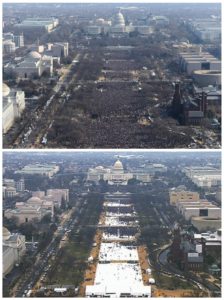
This pair of photos shows a view of the crowd on the National Mall at the inaugurations of President Barack Obama, above, on Jan. 20, 2009, and President Donald Trump, below, on Jan. 20, 2017. The photo above and the screengrab from video below were both shot shortly before noon from the top of the Washington Monument. (AP Photo) NYAJ501

The positive argument was that the spaces filled during the inauguration added up to a very large number.

We do know a few things. So let’s go through the facts. We know that from the platform from where the President was sworn in to 4th Street holds about 250,000 people. From 4th Street to the media tent is about another 220,000. And from the media tent to the Washington Monument another 250,000 people. All of this space was full when the President took the oath of office.

So that’s about 720K.  (Trump claimed it was 1.5 million, when he was at the CIA office, later.)

But here’s the thing.  Estimated attendance at Obama’s ’09 was 1.8 million.  So, even were Spicer’s rebutting argument accurate and his positive argument correct, that’s not even half of Obama’s ’09 number.  It’s not even the 1 million estimated for Obama’s ’13.

There were three arguments Spicer needed to make here, and he only made two of them.  The comparative argument for the superlative (period) needed to be made, too.  And no fudging with gates and ground covering would have fixed that one.
 

Polarization Perfectionism

Hi all, I’m back blogging here at the NS again, after a long break.  Ready to get back to it.  Thanks, John, for keeping the fire burning.

David French, over at National Review, has some pretty dark views about whether the partisan divide will ever be bridged, given the polarization of the political populace.  He makes some nice observations that polarization yields the view that one’s opposition is less open-minded, intelligent, honest, or even hard working than the average American.  (He leaves out the fact that polarization is both the result and cause of the divide, which is that it’s too often that we only talk to and read our own side…).

His argument that we can’t overcome polarization is on the basis of what he sees as who would need to be the leader for it. Namely, the new president, Mr. Trump.  The Donald has alienated folks given the way he’s campaigned (and given the inaugural), so folks don’t trust him.  But even if he were to soften his tone and recognized his political opponents as more than craven losers, French doesn’t think it’d make things better.

…if Trump stopped tweeting, spoke only in the most measured tones, and relentlessly reached out to black and Latino voters while also governing as a conservative, many millions of leftists and their media supporters would still howl in fury at his political program. You would relentlessly hear that Trump was somehow worse now than when he insulted his opponents, because that was only talk, while his policies represent actions.
This is a case of what’s sometimes called the Perfectionist false dilemma.  The reasoning goes like this:
We can either adopt some change to improve things or leave things as they (unfortunately) are.  The change won’t fix everything, nor would any fix be quick.  Therefore, the fix isn’t worth it.
Of course, the conclusion does not follow when it’s put that way.  Why? Because the reasoning leaves out the tertium quid of the ameliorating option of making things a little less bad.  Sure, in the Trump case, people still would distrust him and oppose him.  But that’s likely because of his long and bad history, and moreover, if he (as French notes) doesn’t change  his policies, he would merely be play-acting.  (Sure, if you only change your rhetoric, that’s not going to improve the divide by anything…)
But the main issue would be: if T were to change the rhetoric and actually heard the voices of those who were critical, then there may be some policy shift.  That would help with polarization.  Moreover, if he would take the time to explain his policies to those who disagree, maybe we’d understand why what he’s doing is more than sheer keptocratic manipulation.  But, hey, he’s just the President, not a miracle-worker, right?

Oh, the analogy

A long while back, I noted that most discussions about gay marriage are more like races to who could pose one of the three tired old analogies first.  The three variables are: race, polygamy, and bestiality.  If you can pose the analogy first, you have a kind of dialectical advantage — even if the analogy isn’t perfect.  This is because there’s a kind of defensive posture the opposition must take, once the analogy is posed — they have to answer this line of argument before they can proceed with their own, and this often takes more time and energy than we normally allot for our critical discussions.  And so, for familiar structural reasons (we always have a dearth of time an energy for critical discussion), those who wield the analogy first are those who often get to claim they came out the best.

So much for the strategic argumentative elements of argument by analogy.  There are a few other things to note.  First, all analogies, in the end, are limited.  They can find some relevant feature that’s the same, but they also must have their differences.  Analogies are not identities.  Second, the form of argument by analogy in this context is off of a deep principle of justice:

Treat like cases alike

The strategy with analogy is to identify the similarity between two cases and show that because we have an unproblematic precedent of treatment with one kind of case, we, assuming the deep principle of justice, treat the other case similarly.  And so, if discriminating against gays is like discriminating against blacks, we shouldn’t.  And if discriminating against gays is like discriminating against people who want to have sex with sheep, we should.  Everything hangs on the relevant similarities between the cases, and so, everything hangs on the aptness of the similarities between the cases.  And we should, being good, rational arguers, be open to the possibility that our analogies are weak and the opposition’s are strong.  That happens.

Will Saletan’s post over at Salon is an exercise in this kind of argumentative humility.  He takes the analogy between race and sexual orientation to be a good analogy, but he’s willing to note where there may be relevant moral differences between the two.  Primarily it’s about the issue of having children.

The central, categorical objection to gay marriage is that same-sex couples can’t produce biological children together…. Just because I don’t agree with an argument, however, doesn’t mean it’s irrational. Marriage has historically been a sexual institution. A rational person can maintain that a relationship between two people categorically incapable of producing children together—that is, two people of the same sex—can’t be a marriage. That argument doesn’t justify denying them the right to love one another openly, nor does it justify denying them the benefits and honors we bestow on couples for making lifetime commitments. But it can justify a person’s refusal to accept a same-sex relationship as a marriage.

Saletan’s giving the case for disanalogy it’s due.  He follows this noting:

The argument has plenty of problems. We let old people marry. We let infertile people marry. We don’t insist that married couples produce kids. We welcome adoption and stepfamilies. Gay couples can have kids using donated eggs or sperm. Many gay people are already raising children, and doing it just as well as straight people.

All of that is true. But I’d be remiss to omit the rejoinder from George and his colleagues: Sex is a much brighter line than fertility or intention to bear children. It’s certainly a less intrusive distinction to enforce.

This is now a point about legal treatment – the law isn’t about your intentions with the marriage, it’s about what can reasonably be expected in it.  In this regard, it is right that the case for analogy between race and sex-orientation discrimination is weaker.  But, again, analogies are not identities, and to hold them to the standard that the cases be identical is crazy.

In this respect, I think Saletan’s on the right track both argumentatively and politically to acknowledge that there may be differences between these cases.  But the differences are still insufficient to break the relevance of the analogy.

How to turn your analogy to straw

Marco Rubio recently made an interesting analogy after the release of the CBO report.  He said that the likelihood of the Affordable Care Act (“Obamacare”) actually helping people is as great as the likelihood of the Denver Broncos coming back from their fourth-quarter deficit in the SuperBowl.

I know that there are still some who hold out hope that Obamacare will work, just like there were some in Denver this Sunday still holding out hope that the Broncos could come back and win in the fourth quarter.

Now, there is some debate on the matter, but let’s give Rubio the point for the sake of argument.  However, if we do, then Aaron Goldstein has a critical point to make:

But let’s not forget that the Broncos actually made it to the Super Bowl. The Broncos were the second best team in the NFL in 2013….

If Rubio is going to compare Obamacare to a football team he should invoke the 2008 Detroit Lions who went 0-16. Better still, the junior Senator from Florida could also speak of the 1976 Tampa Bay Buccaneers who went 0-14. This would be a far more apt comparison because when it comes to Obamacare no one wins.

Ah, a lesson in how to turn an analogy into a straw man.  At least the Rubio analogy conceded that the ACA had something going for it (at least the Broncos had a chance to make points back earlier), but Goldstein refuses even that.  Beyond this, the point Rubio was trying to make with the analogy was one of prospects, like for the future, not retrospects, looking at the past.  Oh well, when the objective is to paint your political opponents in the worst lights, saving the actual point is beside the point.

Don’t strawman me… I was strawmanning, myself

(Former) Governor Mike Huckabee has been criticized for the things he’s said about women and birth control.  Here’s the line folks are focusing on:

They cannot control their libido or their reproductive system without the help of the government

The reply is that the Governor did say those words, but the quote is “taken out of context”. As it turns out, the context is that of attributing this view to Democrats.  Here’s Matt Lewis at the Daily Caller clarifying the situation:

If the Democrats want to insult the women of America by making them believe that they are helpless without Uncle Sugar coming in and providing for them a prescription each month for birth control because [DEMOCRATS BELIEVE] they cannot control their libido or their reproductive system without the help of the government, then so be it.

The context of the quote, I think, is correct in terms of the Daily Caller’s clarification. The video HERE.  Huckabee isn’t stating his own view, he’s making it clear what he thinks that Democrats think about women and birth control.  So to criticize him for holding this view is a form of straw manning.

That’s better, but not dialecticaly.  The defense is that the view in question is not one he takes himself, but one he attributes to his opponents on birth control.  (He follows these sentences with a call for further debate on the issue, clearly calling attention to the fact that he sees his opponents as having a wildly indefensible view.)  Note that the address was not to a mixed audience wherein a liberal might say back: that’s not our view, Governor.  The issue isn’t about controlling libido, but having the right to manage when and by whom one has a child.  Isn’t that an important issue?  Ever notice how straw-manning is easier when your opponent isn’t in the room?

So in defending himself against being strawmanned, Huckabee reveals himself  the straw-manner.

To use the full taxonomic vocabulary: My hypothesis is that Huckabee was hollow-manning (nobody on the Democrat side has had a thought like that, right?), and the defense is a form of iron-manning.

Fallacy Man

Existential Comics has a nice series on Fallacy Man, a guy dressed as Zoro who jumps into conversations to point out fallacies.  It’s a nice way to show the dialectical error of only pointing out fallacies – namely, that naming a fallacy form isn’t helpful feedback for the argument.  You’ve got to explain why a premise is irrelevant, or how some forms of inference are based on incorrect data.  Those are all dialectical requirements of reason – exchange.  The best part, of course, is that there’s also the problem of the fallacy fallacy. (You’ve got to read to the end of the comic.)

Now, the fallacy fallacy requires additional dialectical baggage, and I don’t see it in the comic posted.  Here’s the basic form of fallacy fallacy:

Premise: The opposition’s case for their view (P) is fallacious. (Then the list of the fallacy forms identified).

Conclusion 1: The opposition’s view, P, is false.

Conclusion 2: And, further, my view is true.

Now, so far, just listing all the fallacy forms you identify in the opposition’s case isn’t yet proof that their view is false or that your view is true.  BUT: there are a number of considerations that might undercut that.  Note, the opposition may have the entirety of the burden of proof.  And so, were the opposition to have the view that, say, there’s an elephant in the room, and they can’t prove it except fallaciously, then there’s reason to believe that there’s no elephant in the room.  (Otherwise, there’d be evidence).  Or consider this in a legal context — all the defense has to do is point out the failures of argument from the prosecution, because the burden of proof is entirely on those who argue for guilty.  In those cases, there are default conclusions, and when the case to the contrary fails, we revert to them.  So in those cases, fallacy fallacy is no fallacy. To further clarify John’s got a great post on the Fallacy Fallacy Fallacy.

Persecution anxiety

Bruce Chapman reports at AmSpec that Christians are widely persecuted around the world, and one of the prominent examples is the treatment of Coptic Christians in Egypt. Chapman says someone should do something about it.  That’s right.  Ah, but then he hypothesizes why people haven’t already done something about it:

One reason for neglect in Washington is probably the continuing secularization of the West. Political forces that demand that domestic religious organizations provide employees insurance for contraception, that Christmas manger scenes be banned from the town park and that graduating high school seniors not be allowed to invoke God in their valedictory addresses are not the kind of people who care much about Christian prisoners in the North Korean gulag or burning churches in Egypt.

Here’s the analogy behind Chapman’s explanation.  Those who oppose mangers in town squares and compulsory prayer are like those who put Christians in gulags and burn churches — they sympathize with the oppressors.  In Chapman’s eyes, secularism is religious oppression lite.

Chapman’s error is that those who oppose state-sanctioned religious displays do so precisely in the spirit of opposing oppression.  Sure, it may feel like being oppressed when the state capitol doesn’t have a manger scene – you’re not getting complete control over the state.  But that’s not oppression, that’s a reduction in your undeserved and disproportionate power.

And so the analogy isn’t just false, it’s entirely backwards — you get the kind of oppression of gulags and church burnings when you have a state that endorses only one kind of religious view.  You see, the secularization of the West isn’t motivated by the desire to oppress the religious, but by the desire to reduce religious oppression.

Santa brought you a fallacy

USA Today recently reported that “not all Christians believe there is a War on Christmas.”  Most who don’t have this belief have the contrary belief – that not only that there is not a war on Christmas, but that the holiday is doing just fine and one doesn’t need to force it on the non-believers.

But Larry Thornberry at AmSpec sees a fallacy:

A recent USA Today story carried the headline “Not all Christians believe there is a ‘War on Christmas.’”  Hardly surprising. Not all Christians believe Elvis is dead. The obvious escapes many, pious or heathen.

The title of the piece is “Objection, Your Honor. Relevance?”

Two important things.  First, ad populum arguments are not failures of relevance.  Otherwise the fact that something is ‘traditional’ or ‘common sense’ wouldn’t lend any support to anything.  But it does – else conservatism would, at it’s core, be a fallacy.  Ad populum arguments suffer, instead, from problems of weak authority – the matter is whether there are other reasons undercutting the authority or the accuracy of those attesting.

Second, the analogy between those who don’t believe in a War on Christmas and those who believe Elvis is still alive is mighty ridiculous.  The difference between the two is that Elvis-death-deniers fail with empirical evidence.  War-on-Christmas deniers distinguish being oppressed from tolerance.


First, get some straw…

We’ve pretty regularly noted that you can tell a straw man fallacy is coming when the speaker starts the windup for attributing views to his opponent by saying, “Some folks who believe X say…”  or “You know what all those X-ists say about this…”  What generally comes is a view nobody even recognizes as their view, or if it is, it’s only from the least capable of those who hold X.  And so we’ve been calling these hollow and weak men.

Now, what happens when the speaker’s on a roll?  It’s not just a one-off, but a series of these straw-man constructions.  For example, take Marta Mossburg’s “The Real ‘War on Women'” over at the American Spectator.   There are at least three in quick succession.

First, there’s the implication that Democrats who use the expression ‘The Republican War on Women’ don’t care at all about the way women are oppressed around the world.

When Terry McAuliffe, the governor-elect of Virginia,  relentlessly battered his Republican opponent Ken Cuccinelli for waging a “war on women,”  these innocent babies, teenagers and wives often attacked by their families and given no protection under the law throughout many countries in the world were not on his mind, however.  Not even remotely.

Second, there’s the implication of reverse racism in describing the progressive view:

It also fits in nicely with the progressive narrative that history is moving irrevocably forward to some ideal – which does not include stodgy white men.

And third, there’s the simple imputation of sheer craven rhetorical objectives to their opponents:

The success of the “war on women” trope should make Republicans realize that they are fighting progressives for whom the idea of truth is an outdated relic of a racist, homophobic, misogynist past to be discarded in favor of tactics that allow them to win elections and sway opinion.

Now, sometimes, the writing in politico magazines isn’t about making arguments.  Sometimes, it’s just about reminding people what’s at stake, motivating them to go out and win, galvanizing the side.  But here’s the thing: dog-cussing your opponents like this makes it very hard to intellectually engage with them afterwards.  It inculcates a habit that Talisse and I have been calling the No Reasonable Opposition perspective on the issues at hand.  And when you don’t see the opposition as reasonable, you don’t work on developing good arguments, and when you don’t work on good arguments, you don’t maintain your best reasons.  And then you become, ironically, just like the folks you were dog-cussing.

To the three straw men here, it’s worthwhile to say the following.  1. The “Republican War on Women” trope was about a series of elections and domestic policy, not about foreign policy.  You focus on what’s different between the two candidates and parties in that argumentative context and about the things they will determine – to talk about the treatment of women around the world is not what that discussion is about.  (One might call this, by extension, a form of red herring.)  2. There’s a difference between having less (unearned) influence and having no influence – if everybody gets a fair shake, there are going to be fewer white guys at the top.  It shouldn’t be hard to see that.  3. As to the cravenness view of one’s opponents, I’ll simply say that if you, yourself, aren’t very good at constructing good arguments, you won’t be very good at detecting them, either.


Ad Fuhrer-em

We’ve been doing a lot of Ad Hitleremspotting these days at the NS, but, hey, it’s the season of the Godwin.  Check out the statement from Brenda Barton (R) from Arizona on Facebook:

Someone is paying the National Park Service thugs overtime for their efforts to carry out the order of De Fuhrer… where are our Constitutional Sheriffs who can revoke the Park Service Rangers authority to arrest??? Do we have any Sheriffs with a pair?

I object for a few reasons.  First is just linguistic.  It’s der Fuhrer.  Second is analogical – how in any way is using the force charged with protecting the parks to close the parks like Hitler’s abuse of power in Germany? And park service rangers are given police force training.

Here’s the rich part.  Barton’s responded to criticism of her post, and she’s issued the following clarification.

What I did suggest, rather directly, was that the National Park Service enforcement personnel (referring to them as ‘thugs’ for their reported behavior) were simply following orders of ‘their leader’ – and I used the German phrase for emphasis, Der Fuhrer. . . .I am referencing the Presidents behavior as indicated by his actions. The Merriam-Webster New Collegiate Dictionary defines ‘Fuhrer’ as ‘(2) a leader exercising tyrannical authority. . . . As many are aware, some recent comments of mine on Facebook have touched a sensitive nerve with many people. Additionally, many have simply taken my posting out of its contextual environment. . .  Had I chosen my words differently, or had the President offered to use the power of his office to lessen or mute the public impacts of this impasse in Washington, we might not be having this discussion.

OK, so the defense is as follows:

1. When I use ‘De Fuhrer’ I just mean ‘tyrant’

2. When I used the term it was for emphasis, and to take it as more is to take it out of context.

3. It’s the president’s fault that I had to compare him to Hitler.

Point-for-point, silly.  In fact, to use 1 and 2 together is inconsistent.  The term ‘Fuhrer’ has the emphasis it does not because its usage as leader, or even tyrant, but as THAT tyrant named Adolph.  The context of using ‘Fuhrer’ is the context of exemplifying Godwin’s Law.  3 is amazing.  In effect – it’s not my fault that I can’t think of another apt analogy… I mean the guy’s literally like Hitler when he does this!   (This is, really, a case of instead of backing away from the Ad Hitlerem, but embracing it!)