Category Archives: General discussion

Anything else.

Philosophy15 – Why Argument Must Be Dialectical

Over at Philosophy15, Talisse and I have a short bit on why argument must not only have the core relation between premises and conclusions, but also must have a dialectical element to it.  A familiar point for those who are regular NS readers, but worth a  quick posting.

A consequent point is that it looks like the dialectical element to argument leads to a few skeptical problems for those who think that democracy must be deliberative.  (We follow up on that in the next episode.)

Trump and Poe’s law

One common explanation for the sufficient (because that’s what it was in the end, wasn’t it) popularity of Trump and Trumpism was the idea that he didn’t play by the rules of the elite (he did, but that’s not the point). Some even suggested that not having facts and evidence or making discernible (not to mention valid or cogent) arguments for his views was the heart of the appeal. If true, this would explain the difficulty or disregard they have for such basic notions as “facts” (or logical notions such as use/mention). It also explains how he seems to be insulated from the charges he leveled at Hilary Clinton: he has employed the swamp (rather than drain it) and reportedly his staff, such as it is, uses private email servers (and he uses his insecure private phone). The frustration of the consistency police at these things is a further part of the appeal.

It turns out there is yet another benefit to this strategy: he’s impossible to satirize. Enter Matt Stone and Trey Parker  of “South Park” fame (from the Huffington Post):

”South Park” is done with Trump ― at least for the moment.

The show’s creators, Trey Parker and Matt Stone, said in an Australian interview Thursday that they’ve decided to “back off” on satirizing President Donald Trump because his administration is already creating tough-to-top comedy.

“It’s really tricky now because satire has become reality,” Parker told the show “7.30.”

“It’s really hard to make fun of,” Parker continued. “We were really trying to make fun of what was going on but we couldn’t keep up … and what was actually happening was way funnier than anything we could come up with.”

“So we decided to kind of back off and let them do their comedy and we’ll do ours,” he said.

It’s Poe’s law (discussed by Scott here) regarding Trumpism. In this case, it’s not only that the view is indistinguishable from satire, it’s that the view outstrips satire. Poe’s law is meant to be a heuristic for when a view is not worth considering.

This has an interesting consequence for argument theory. Normally, a view that’s too stupid to characterize is not worth one’s time. Usually in these circumstances, there are other views on the table–better ones. You can critique those. Indeed, the satire works because the view is bad. You can see the good view in it. In this case, there is no alternative available. This is a view that needs evaluation and offers no alternative. Going after Burkean conservatism would be irrelevant.

All of argument relies on the fundamental requirement that you can represent a view. If Poe’s law is the measure of basic acceptability, then we’re in serious trouble.

The Clearing the Decks Fallacy

Talisse and I have a short bit at Philosophy15 on a new fallacy we’ve been seeing in philosophy.  Well, really, it’s not a new phenomenon, we’ve just started noticing it. One reason is that we’ve become particularly interested in how dialectical standards change over extended philosophical work. Here’s the basic setup.

Stage 1: Hold one’s dialectical opponents to a very high standard of scrutiny.   Show that they do not pass that level of scrutiny.

Stage 2: Deduce that the standard of scrutiny is likely too high, and then introduce a new, lower standard.

Stage 3: Show that one’s own view passes the lower standard.

The problem is that in many cases, the other views criticized in Stage 1 would pass the lower standard in Stage 3, just as one’s own view does.  But they don’t get mentioned in stage 3.  So the argument proceeds as though their being eliminated by the high standards eliminates them full stop.

This strategy we call clearing the decks.  It shows up lots in the history of philosophy, and it is particularly noxious when philosophers do metaphilosophy.

The basic rule, we think, that gets broken is a form of the rule that in deliberating between choices, one uses a consistent standard for the ultimate decision.  It’s not that one must use the same standard throughout, as we can find that some standards are too strict or lax and need to change them.  It’s just that when we make the final decision, we apply the same standard to all eligible options.  With clearing the decks, once the standard is lowered, there are more eligible options.   In some ways, it’s a form of argument from double standards.

More on Alternative Facts

Talisse and I have a short piece over at 3QuarksDaily on the heat/light ratio in the ‘Alternative Facts’ reaction.   In many ways, it’s a follow-up to John’s earlier observation that Conway, on a more charitable interpretation, should have used a term like ‘rebutting’ or ‘complicating’ facts, since she’s talking about the evidence for the attendance claims.

The point: a little training in the argumentative culture of the humanities helps with these distinctions. The sad irony is that a representative of the Trump administration is hamstrung by the use of language in an area the administration is actively trying to undermine.


Alternate facts

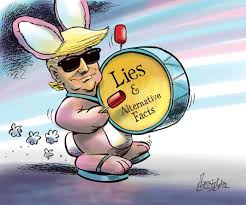
Boing Boing’s Facebook page shared a Little Golden Book parody mocking Conway’s use of “alternative facts.”

By now, we’re all familiar with Trump Adviser KellyAnne Conway’s remark about “alternate facts.” If not, a brief summary:

The outrage over “alternative facts” began Sunday, when Conway appeared on “Meet the Press” and defended press secretary Sean Spicer’s inaccurate statement about the size of inauguration crowds.

“Sean Spicer, our press secretary, gave alternative facts,” Conway said.

“Wait a minute,” host Chuck Todd countered. “Alternative facts? … Four of the five facts he uttered were just not true. Alternative facts are not facts. They are falsehoods.”

That has led to all sorts of internet hilarity (my favorite is the picture above). More on this in a second.

Sadly, however, this is an instance in which it’s clear that Conway means or should mean “rebutting facts” or “challenges to those facts.” To be precise, we probably should be talking about “alleged” facts in this case, or better, “claims.” A little charity and precision, in other words, would do much to clarify the matter.

Once we settle this common language problem, we can determine who is more likely to be right about this (not them). This is really what we ought to be focused on anyway (although, this particular question seems completely pointless). We’ve got, after all, a well-established way of settling these things. It’s not great, but it’s well-established.

This raises a question, however, as to whether this choice of term (“alternate facts”) is just the point.  This “alternate facts” stuff sure provokes a lot of laughter from logic types like yours truly. And perhaps this is just the point.  Sad.

The Ring of Gyges

Image result for gyges greek mythology

For many years now, I’ve used the anonymity of internet comments as an example of the Ring of Gyges in the first book of Plato’s Republic. No doubt you’re familiar with the idea: given a ring of invisibility, would you be a jerk or not? The internet sometimes grants a kind of anonymity with regard to dialectical exchanges on the internet. If you don’t have to reveal who you are, will you write the uninhibited comment rich with all manner of ad hominem? The thought was that lots of people would.

Well, it turns out this thought was probably wrong. Research seems to indicate that internet anonymity does not contribute to debased debates. It’s (partially) something much more satisfying (to me): lack of regulation:

Clear social norms can reduce problems even when people’s names and other identifying information aren’t visible. Social norms are our beliefs about what other people think is acceptable, and norms aren’t de-activated by anonymity. We learn them by observing other people’s behavior and being told what’s expected [2]. Earlier this year, I supported a 14-million-subscriber pseudonymous community to test the effect of rule-postings on newcomer behavior. In preliminary results, we found that posting the rules to the top of a discussion caused first-time commenters to follow the rules 7 percentage points more often on average, from 75% to 82%.

This is somewhat heartening, I think. It holds out hope that people can channel their energies more productively in clearly regulated environments, like this one (so, no ad hominems, jerks).

Fallacy theory and democracy

Instead of writing something myself today, I thought I’d post a link to this interesting piece by Scott Aikin and Robert Talisse on Democracy and the Owl of Minerva Problem. A critical graph:

We argue in our natural languages, and so often when we argue, we argue over economies, animals, environments, poverty, and so on. But arguments are structured collections of statements that are alleged to manifest certain kinds of logical relations; consequently, they, too, can be the subject of scrutiny and disagreement. And often in order to evaluate a claim about, say, poverty, we need to attend specifically to the argument alleged to support it. In order to discuss arguments, as arguments, we must develop a language about the argumentative use of language. That is, we must develop a metalanguage. The objective in developing a metalanguage about argument is to enable us to talk about a given argument’s quality without taking a side in the debate over the truth of its conclusion.

The critical idea is that our theory about deliberative debate always follows the debate itself. This explains our ill-preparedness for what these debates offer. See: 2016.

No fair!

Scott and I wrote a piece for an anthology of fallacies (I think the title is still up in the air). One of our contributions was on the straw man (of course!), the other was on the “Free Speech Fallacy.” Here is how we defined it:

The fallacy arises when a contributor to a critical exchange confuses the protected freedom of expressing an opinion with correlate obligations to reply to freely expressed critical opinions of others.

I ran across an instance of this yesterday from VPEOTUS Mike Pence. Here’s the passage:

Lewis joins a handful of congressional Democrats who say they won’t attend Inauguration Day on Friday, when Trump, a Republican, becomes the country’s 45th president.

“I think the Russians participated in helping this man get elected. And they helped destroy the candidacy of Hillary Clinton,” Lewis also said in his interview with NBC’s “Meet the Press.”

On Saturday, Trump retaliated against Lewis for the remarks.

“Lewis should spend more time on fixing and helping his district, which is in horrible shape and falling apart,” Trump tweeted.

Trump, in a follow-up tweet Saturday, said Lewis should spend more time helping his “crime invested” district, instead of “falsely complaining about the election results.”

“All talk, talk, talk — no action or results. Sad.” Trump concluded.

Pence argued Sunday that Trump “has the right to defend himself.”

Whatever the context, what’s not on the table is PEOTUS Trump’s right to defend himself. What is on the table is whether his defense–or indeed Lewis’s criticism–is any good (it doesn’t seem to be, sad!). The question of rights here is, as it is so often, irrelevant.

And I think this actually points to a more generalizable problem in dialectical exchanges: call it “irrelevant rule-invocation.”* It consists in avoiding the substance of the dialectical exchange by alleging violations of rules that do not bear on the substance of the dialectical exchange. So, for instance, if I say, “I think A’s comment p was false.” Respondent B might say, “how dare you attack A!” But I’m not attacking A, I’m challenging A with regard to p. Alleging I’m breaking some rule is an attempt to disqualify me from further participation, since I’ve broken some key argument norm. But alas, I haven’t.

Anecdotally, I’m struck by how quickly this happens. The first move in an argumentative exchange seems pretty frequently to be just this.

*I’ve got to think of a better name (or someone point me to where this has been identified and described).
The Transformer Man

Every critical engagement requires some critic A to represent some B’s position p. Ideally, A accurately presents B’s p in addressing it. Sadly, it’s never that simple. What counts as B’s p is often very difficult to determine. It’s especially difficult because of A’s urge to score points on B and B’s desire not to be scored on. With regard to the latter, B has a number of options. One is to change positions. One way to do this is to “move the goalposts.”  Moving the goalposts is a question of degree. Say B argues for some p, but the evidence for p doesn’t stack up, so B claims some diminished form of p, call it p*. This, with little p and p*, by the way, is how you do philosophy.

Now consider another version of this. B clearly argues for p. But it turns out that p is false. B doesn’t modify p with p*, but rather replaces p with q. All along, B alleges, q was meant. By implication, A’s an idiot or dishonest for not understanding this.

This is what is going on here (Conor Lynch at Salon.com):

As Trump has packed his administration with lobbyists and industry insiders, many liberal commentators have mocked Trump voters as misinformed, credulous idiots, while shoving his swampy cabinet picks in their faces. Such liberals have missed something fundamental about Trump’s populist rhetoric. For many of the millions who voted for Trump, the “swamp” in Washington doesn’t necessarily denote corporate insiders, Wall Street executives and K-Street lobbyists — as those of us on the left visualize — but arrogant technocrats, bookish intellectuals and politically correct liberal elites who are indifferent to the struggles of the “forgotten men and women” in middle America.

I can’t think of a more strained reading of the “drain the swamp” than this. Here’s an analysis, if you’re interested, of the actual words and context.  I don’t mean to deny that Trump might be “anti-intellectual,” whatever that might mean. Rather, this is not at all what he meant by that phrase (he has admitted that he didn’t like it). I can tell because the author of this piece doesn’t bother trying to make the case for this interpretation. He’s just substituted it in. He’s switched goalposts.  Of course on this method just about anything counts as “draining the swamp.”

This all turns out to be hugely insulting to the people (gleeful liberals included) who took Trump literally when he said “drain the swamp”. The funny thing about this is that Lynch doesn’t appear to be some kind of Trump surrogate. He’s just offered up this crazy interpretation on his own, for no reason.

So we have something totally novel (something identified, by the way, by one of Scott’s daughters). Instead of A and B and p, we have A and B and C and p and q. A charges B’s p is false. B replies that it was not p but p*. C comes along and says that B never argued for p or p*, but rather q and that A and B are both idiots. What do we call C, then? C is the Transformer Man.