Replace and defend

Deep Insights

A follow up on David Brooks’ piece on the inadvisability of marijuana legalization.  Perhaps you’ll recall that Brooks told a very personal tale of his own adolescent adventure with marijuana.  TL;DR: marijuana should remain illegal (also because of nature and the arts). A charitable reading of this argument would go thusly: Brooks himself continues to pull tubes, with the consequence being that his arguments are terrible, so don’t legalize marijuana, lest you end up a bumbling fool like David Brooks.  He kind of says as much:

I think we gave it up, first, because we each had had a few embarrassing incidents. Stoned people do stupid things (that’s basically the point). I smoked one day during lunch and then had to give a presentation in English class. I stumbled through it, incapable of putting together simple phrases, feeling like a total loser. It is still one of those embarrassing memories that pop up unbidden at 4 in the morning.

I’m still embarrassed for him.  In any case, rushing to his defense is the allegedly unstoned Reihan Salam, of the National Review (via Lawyers, Guns, and Money).  His argument is the perfect iron man.

The column has prompted an ungenerous and largely uncomprehending response from people who are attacking David as a hypocrite, and worse. But you’ll notice, if you know how to read, that Brooks isn’t endorsing draconian legal penalties for marijuana use. Rather, he is suggesting that legalization as such might not be the best way forward. Though I imagine I don’t agree with Brooks in every respect on this issue, I think his bottom line is correct. The goal of marijuana regulation, and the goal of alcohol regulation and casino regulation and the regulation various other vices, ought to be striking a balance between protecting individual freedom while also protecting vulnerable people from making choices that can irreparably damage their lives and the lives of those closest to them.

This fellow has just made up an entirely different argument: Brooks did not argue for regulation of marijuana.  Nor, in fact, does his column even suggest this.  Nor would any sane (non stoned libertarian) argue for unregulated legalization.  Just for reference, here’s how the obviously stoned David Brooks characterizes legalization:

We now have a couple states — Colorado and Washington — that have gone into the business of effectively encouraging drug use. By making weed legal, they are creating a situation in which the price will drop substantially. One RAND study suggests that prices could plummet by up to 90 percent, before taxes and such. As prices drop and legal fears go away, usage is bound to increase. This is simple economics, and it is confirmed by much research. Colorado and Washington, in other words, are producing more users.

Yet, according to Salam, Brooks is not arguing against legalization.  So this is a beautiful example of argument defense by complete replacement: when the argument you need to defend really sucks, no matter: replace it with a completely different argument, then accuse your opponents of straw manning.  It’s a double fallacy.

Question for the readership then: must the iron man always involve a straw man?  Seems like it might.  In strengthening an argument beyond what it deserves, I distort the critics’ view of the argument as weak.

David Brooks has taken it easy for all of us sinners

Our dystopian future

John Holbo at Crooked Timber reads David Brooks’ recent column on marijuana and has a request we’ve had for a long time:

Why is this interesting? I’ve said it before, and this column is a good example.In US politics, the conservative imagination is so loopily half-utopian. Prominent liberal pundits, by contrast, don’t go in for this sort of half-baked (no pun intended!) goofiness. (Maybe that’s why they don’t get invited onto the Sunday morning shows. They are less entertaining.) But maybe this is just my liberal bias. A challenge for our conservatives readers. Can you provide examples of liberal pundits who are as prominent as Brooks, who are as goofy as Brooks?That is, they defend some concrete policy proposal by sort of half-flying off to some vague Cloud Cuckooland, based on principles they would never seriously propose ratifying in the real world, because they obviously don’t even believe those principles?

As an empirical matter, I think Holbo is right on the money.  We have, on the one hand, a very vibrant argumentative culture in the United States; you don’t have to go very far to find vigorous dialectical exchanges on any number of topics (see, the Internet).  At the same time, however, this culture is dominated by the likes of Brooks (and Kathleen Parker).

Brooks, the particular case at hand, argues the following:

For a little while in my teenage years, my friends and I smoked marijuana. It was fun. I have some fond memories of us all being silly together. I think those moments of uninhibited frolic deepened our friendships.

Only to conclude:

The people who debate these policy changes usually cite the health risks users would face or the tax revenues the state might realize. Many people these days shy away from talk about the moral status of drug use because that would imply that one sort of life you might choose is better than another sort of life.

But, of course, these are the core questions: Laws profoundly mold culture, so what sort of community do we want our laws to nurture? What sort of individuals and behaviors do our governments want to encourage? I’d say that in healthy societies government wants to subtly tip the scale to favor temperate, prudent, self-governing citizenship. In those societies, government subtly encourages the highest pleasures, like enjoying the arts or being in nature, and discourages lesser pleasures, like being stoned.

In legalizing weed, citizens of Colorado are, indeed, enhancing individual freedom. But they are also nurturing a moral ecology in which it is a bit harder to be the sort of person most of us want to be.

Skipping the obvious rejoinder of the legality of alchohol and workahol, smoking weed was good for Brooks, morally good actually (it deepened his friendships, didn’t it?), but it ought to be illegal for others (with, I imagine, all of the consequences of being illegal–jail, fines, war on drugs, etc.) because nature and the arts are better.  I think you’d have to be high to cite those two particular examples of alternatives to weed.  And so maybe we’re reading this all wrong.  Brooks is enacting his argument against  legal weed by getting high before writing it.

3:AM Magazine

3:AM Magazine has an interview with our own Scott Aikin.  Get it here.  A sample:

3:AM: Your new book is about the social nature and political significance of argument. You see argument as any attempt to think things through, talk things over or figure out by means of processes aimed at sharing and evaluating reasons. The originality of this is that you broaden the idea of ‘argument’ out considerably so you catch what you call ‘dialectical fallacies’ . So can you first say something about what you’re doing here – and how it contrasts with more common approaches to evaluating arguments – and what a ‘dialectical fallacy’ is.

SA: The first step is to acknowledge that the term ‘argument’ captures two types of things. On the one hand, arguments are informational products – sets of premises and conclusions bearing logical relations to each other. On the other hand, arguments are processes and performances – reason-exchanges between people for the sake of resolving a dispute by finding out what’s true. For the most part, philosophical interest in argument has been focused on the product-side of argument, and the process-side has been left to rhetoric. This is lamentable. First, because the focus of rhetoric isn’t about what normatively appropriate methods there are, but about what methods yield assent. Second, because there are norms of argument as a process that are truth-oriented.

So consider the old straw man fallacy. It’s hard to say what’s wrong about it from a formal perspective, as a straw man fallacy entails erecting a fallacious argument and criticizing it. Nothing is formally wrong with that, but what’s informally wrong is that you’re not hooking up with the arguments and views those who oppose your views have. It’s a kind of misfire between interlocutors. So there are groundrules for good arguments, ones that arise out of (or are the conditions for) the exchange of reasons. And one of those groundrules is that if we are jointly weighing reasons, we accurately assess each other’s reasons – to distort the other’s reasons subverts the process. Consequently, to take on this notion of dialectical fallacy, you’ve got to take on this pragmatic perspective on argument – we’re out for the truth (or at least understanding) by way of the honest exchange of reasons.

Read the whole thing.


Masters of war

This morning, I caught the tail end of an NPR interview with David Kilcullen who has written Out of the Mountains, a book about war.  One point he made struck me: some people make conflict their business.  These people are conflict entrepreneurs.  I know this is kind of obvious–the masters of war and all–but you do not hear much about it in descriptions of conflicts.  You will hear about the reasons group x has gone to war with group y, but you will not hear about, as parties to the conflict, people whose interests lies in the conflict itself.  These people are war trolls.  He says:

And to me that’s a great example. Right now we have what I would call a lot of conflict entrepreneurs. They’re prolonging conflicts not because they want to win some political goal or because they want to change the form of government of a particular area, but just because they make a lot of money, they get a lot of power from conflict and they want to preserve that conflict to keep going. So I think part of it is about shifting people away from being conflict entrepreneurs to being stakeholders in a peaceful environment.

This is another under-theorized (in my mind at least) connection between just war theory and argumentation.  Argumentation tends to take as its central focus the study of reasons–good ones, bad ones, etc, as they are oriented towards the objectives of argumentation (being correct, convincing, etc.).   So we watch Bill O’Reilly and we shake our heads at the poverty of good reasoning, thinking him and his ilk to be ignorant or dishonest.

Maybe, however, their objectives are not the objectives of anyone else: they’re not trying to be correct, to show someone else to be incorrect, maybe they’re not even trying to win an argument at all.  They’re just making sure that unresolvable argumentation continues indefinitely.  This is their job.

**UPDATE: links, other info added above.

Iron manning means not having to know what you’re defending

As devoted Non Sequitur readers know, the iron man is a kind of reverse straw man.  This is to say that it’s unjustifiably strengthening someone’s argument so as more easily to defend it.  This interview with Sarah Palin is the very essence of iron manning.  You see, Palin doesn’t even need to know what Phil Robertson, the Duck Dynast, has said (or what the criticisms of it are) for her to defend him.  From TPM:

Fox News host Greta Van Susteren asked Palin if she took issue with the manner in which “Duck Dynasty” patriarch Phil Robertson made his comments, which Van Susteren characterized as “graphic” and “offensive,” even if she agreed with the substance of what Robertson said.

“I haven’t read the article. I don’t know exactly how he said it,” Palin responded. “But what he was doing was in response to a question about a lifestyle he disagrees with, and yet he has said over and over again he doesn’t hate the person engaging in a lifestyle he disagrees with.”

That speaks for itself.  For reference, here’s what he said (from the GQ article):

Start with homosexual behavior and just morph out from there. Bestiality, sleeping around with this woman and that woman and that woman and those men,” he says. Then he paraphrases Corinthians: “Don’t be deceived. Neither the adulterers, the idolaters, the male prostitutes, the homosexual offenders, the greedy, the drunkards, the slanderers, the swindlers—they won’t inherit the kingdom of God. Don’t deceive yourself. It’s not right.

Then there’s this (which is just kind of hilarious):

For the sake of the Gospel, it was worth it,” Phil tells me. “All you have to do is look at any society where there is no Jesus. I’ll give you four: Nazis, no Jesus. Look at their record. Uh, Shintos? They started this thing in Pearl Harbor. Any Jesus among them? None. Communists? None. Islamists? Zero. That’s eighty years of ideologies that have popped up where no Jesus was allowed among those four groups. Just look at the records as far as murder goes among those four groups.

For the record, Islam includes more than 0 percent Jesus, and it’s also more than 80 years old.

Maybe you’re the problem

Hacks

In their recent book (and in their TV appearances!), Why We Argue, Scott and Rob make the case for vigorous, meaningful, and competent public argument.  The competence part of this is the most obvious.  Logic texts have long made the case for this, taking a “skills” approach to the subject–learn to reason well, and you will reason well.

Well, that’s not the case.  Smart Harvard types have long been the most vigorous practitioners of the fine art of sophistry (for evidence, see anyone of our 1500 or so posts here).  The problem with these guys isn’t the lack of vigor, they’ve got lots of that.  The problem is the “meaningful” part.  They don’t, or can’t possibly, mean what they say.  They’re hacks.

A fundamental presupposition to productive argumentation, after all, is that the other person arguing means what she says.  Hacks do not mean what they say.  They take the party line whether it’s the best available view or not.  So I find it disturbing to read this post by Jonathan Bernstein, defending them.  His main reasons:

I think Chait is talking about something like a “public intellectual” model, and what I’d say is that there’s also room for a lawyer model. For a lawyer-model pundit, it doesn’t matter so much if she said the exact opposite thing five years ago, but it still matters a lot if she gets her facts right and makes well-reasoned, well-informed, arguments.

I guess the question is whether there’s really any need for lawyer-style commentators, given that it’s the professional responsibility of many politicians to essentially do that. I’d say: sure. Commentators, as opposed to politicians or their staff, are relatively free to make the argument properly, without having to worry about the political fallout from the various speed traps and potholes that politicians have to shy away from — or from winning daily spin wars.

The hack, by definition, is not making the “argument properly.”  Part of making the argument properly is believing what you say.  The lawyer doesn’t have to believe what she says because there’s a judge, a jury, a process for evaluating (and restricting) their utterances.  Hacks throw themselves into a game claiming to be something they’re not.  This, I think, is fundamentally destructive to argumentation.

To be fair, this is pretty much how Bernstein concludes:

Granted, it’s unlikely that anyone is going to identify himself as a lawyer-style commentator. And yes, one tip-off that Krauthammer isn’t worth bothering with is his extreme certainty that he’s correct, even as (as Chait notes) he flips from one side to another of an issue based on partisan tides. But overall, there’s probably a lot more room for good lawyer-style pundits than Chait thinks.

Granted indeed, and good example!  But that’s really the entirety of Bernstein’s case.

ad effeminandos animos*

The above image was tweeted by Barackobama.com last week. I suppose the idea is that people should talk about health insurance while they do the usual non-alcoholic holiday things.

Sadly, this image has also forced some people to regress to adolescent bullying. Here’s the always regrettable Jonah Goldberg:

If you try to play out the life of Pajama Boy in your mind, he probably has a girlfriend. It’s just that she’s wearing the pants in the relationship, as they used to say. I picture her like Sarah Silverman in School of Rock or the girlfriend at the beginning of Office Space who everyone knows is cheating on Peter.

[…]

Pajama Boy is a Low-T liberal who wears a “this is what a feminist looks like” T-shirt and flinches whenever his girlfriend makes a sudden movement…

So the argument goes like this: the sissy in the photograph, who has a girlfriend who physically dominates him, demonstrates that the Affordable Care Act does not address America’s health care needs.

*Caesar, de Bello Gallico I.1: “Of all these, the Belgae are the bravest, because they are furthest from the civilization and refinement of [our] Province, and merchants least frequently resort to them, and import those things which tend to effeminate the mind”

Persecution anxiety

Bruce Chapman reports at AmSpec that Christians are widely persecuted around the world, and one of the prominent examples is the treatment of Coptic Christians in Egypt. Chapman says someone should do something about it.  That’s right.  Ah, but then he hypothesizes why people haven’t already done something about it:

One reason for neglect in Washington is probably the continuing secularization of the West. Political forces that demand that domestic religious organizations provide employees insurance for contraception, that Christmas manger scenes be banned from the town park and that graduating high school seniors not be allowed to invoke God in their valedictory addresses are not the kind of people who care much about Christian prisoners in the North Korean gulag or burning churches in Egypt.

Here’s the analogy behind Chapman’s explanation.  Those who oppose mangers in town squares and compulsory prayer are like those who put Christians in gulags and burn churches — they sympathize with the oppressors.  In Chapman’s eyes, secularism is religious oppression lite.

Chapman’s error is that those who oppose state-sanctioned religious displays do so precisely in the spirit of opposing oppression.  Sure, it may feel like being oppressed when the state capitol doesn’t have a manger scene – you’re not getting complete control over the state.  But that’s not oppression, that’s a reduction in your undeserved and disproportionate power.

And so the analogy isn’t just false, it’s entirely backwards — you get the kind of oppression of gulags and church burnings when you have a state that endorses only one kind of religious view.  You see, the secularization of the West isn’t motivated by the desire to oppress the religious, but by the desire to reduce religious oppression.

Santa Baby

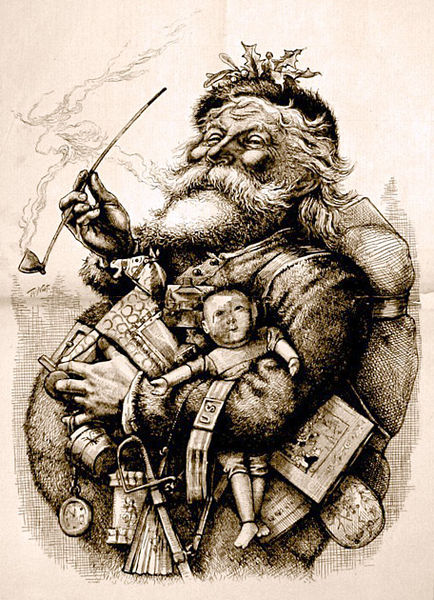
Photo of Santa

People are probably familiar with the controversy over the racial identity of Santa, Santa Claus, or St.Nick, or Saint Nicholas.  TL;DR: Megyn Kelly, Fox News personality, alleged that “Santa is white” and Jesus was white” are “historical facts.”  See here for discussion

According to some of the older kids at my school, there really isn’t a Santa, he’s just you’re parents.  This explains why a lot of very good kids don’t get any presents at Christmas.

This also explains why this assertion from Bill O’Reilly makes no sense (from TPM):

“In this case, Megyn Kelly is correct. Santa was a white person”

“was,” that’s funny, it’s almost as if O’Reilly thinks Santa no longer exists.

Your argument is invalid