Hey NS readers, John and I will be at this year’s Ontario Society for the Study of Argumentation (OSSA) meeting. We are planning on blogging the papers we attend, with thesis and argument summary and highlights from the Q&A. We did a run at this last year, and some of the discussions were very interesting. Here’s the conference website program with a good list of the paper abstracts. The papers start up in full force Thursday. Additionally, we’ll post our paper for our joint presentation for the NS readership to give some feedback, and we’ll make sure to post the most serious objections.
Category Archives: General discussion
Anything else.
A Harvard Ph.D. should have been able to figure out what was going on

Jason Richwine, Heritage Foundation scholar and Harvard School of Public Policy PhD, was forced to resign last week after people actually read some of his work. Here’s conservative commentator Byron York:
On Friday morning, the 31 year-old scholar resigned from the Heritage Foundation, where he had co-authored the new report, “The Fiscal Cost of Unlawful Immigrants and Amnesty to the U.S. Taxpayer.” The paper, released last Monday and written largely by Heritage scholar Robert Rector, argued that Hispanic immigrants to the United States, most of them low-skill, end up costing the government more in benefits than they pay in taxes. It was an explosive entry into the debate over the comprehensive immigration reform measure currently being considered in the Senate. By the time of its release, reform advocates on the left and right had already published a number of “prebuttals” arguing that Rector and Richwine had it all wrong, that in fact immigration would be a net benefit in years to come.
Heritage expected that debate. What it did not expect was the firestorm that broke out Wednesday morning when a liberal Washington Post blogger posted an article titled, “Heritage study co-author opposed letting in immigrants with low IQs.” The blogger, Dylan Matthews, wrote that Richwine, who earned a doctorate from Harvard University in 2009, had written a dissertation, “IQ and Immigration Policy,”which argued that on average immigrants to the U.S., particularly Hispanic immigrants, have lower IQ scores than “the white native population.” Admitting immigrants with higher IQs, Richwine argued, would be a better immigration policy than admitting low-IQ newcomers.
. . . .
It got worse. In the 24 hours that followed the Post’s initial report, other outlets noted that in 2010 Richwine published two articles on a website called AlternativeRight.com, which describes itself as “an online magazine dedicated to heretical perspectives on society and culture” but is better defined as a site with a strong white nationalist perspective. Then a web video surfaced of Richwine saying, during a 2008 panel discussion, “Decades of psychometric testing has indicated that at least in America, you have Jews with the highest average IQ, usually followed by East Asians, then you have non-Jewish whites, Hispanics, and then blacks. These are real differences, and they’re not going to go away tomorrow, and for that reason we have to address them in our immigration discussions and our debates.“
To repeat, this is the description of a conservative commentator. Here’s how he then sets up Richwine’s reply:
By Friday, he was saying his goodbyes at Heritage and wondering what had happened. “It still amazes me that it would be me who is portrayed this way,” Richwine says. “I have a pretty good educational background, I have a good background in doing very good quantitative work. The idea that I am some sort of foaming-at-the-mouth extremist never even crossed my mind.”
They should have fired him for that view: you don’t have to be “foaming at the mouth” or “extremist” to hold wrong or ill-formed racist views. As a matter of fact, not being an ignorant extremist just makes the charge more damning. York makes effectively the same point:
That is true, but assessments of AlternativeRight at the time of its founding pegged it as a white nationalist site. The site’s editors “hide their sexist and racist ideologies behind the gloss of sweet-sounding, pseudo-intellectual terms,” wrote Tim Mak, then a reporter for David Frum’s old site FrumForum. “Instead of spouting racism, Alternative Right is engaging in the much more respectable-sounding analysis of ‘human biological diversity’ and ‘socio-biology.'” Mak’s article appeared the same week Richwine published his piece for AlternativeRight.
And even if the words in the site’s articles sounded respectable, a Harvard Ph.D. should have been able to figure out what was going on.
Ouch.
Here’s the skinny

Putzing around the internets the other day I ran across an example of an interesting and very common kind of downplayer. Some context, the CEO of Abercrombie and Fitch (see above), a clothing retailer, has claimed he only wants to sell clothes to thin, attractive people:
“In every school there are the cool and popular kids, and then there are the not-so-cool kids. Candidly, we go after the cool kids. We go after the attractive all-American kid with a great attitude and a lot of friends. A lot of people don’t belong (in our clothes), and they can’t belong. Are we exclusionary? Absolutely.”
So he’s a jerk. Now comes the downplayer. Reacting to the story, Shana Lebowitz of Greatist writes:
It’s truly incredible that these news stories have sparked such intense conversations about the way the media helps shape our relationship to our bodies. At the same time, it’s too easy to point fingers at Abercrombie and media outlets that glorify the thin ideal. Sometimes it seems like all we need is a couple of models and mannequins who aren’t stick-thin and everyone’s body image would significantly improve.
But that’s too easy. In reality, skinny models and mannequins don’t cause anyone to feel any way about their bodies. While we can’t always control the size of the T-shirts on Abercrombie’s shelves, we do have the power to walk through the overly cologned aisles without feeling bad about ourselves. So why don’t we arm people with the psychological tools to develop a healthy body image — even in spite of messages that can damage our self-esteem?
Perhaps it is easy to latch onto this guy’s sorry but unsurprising attitude about attractiveness, popularity, and so on. But really, so what? Things that are easy, however, not any the less true or worthwhile on account of their ease.
Further, note how the downplayer turns into a straw man: tweaking one or two things about stores or clothes sizes will not solve every single problem! No kidding! Who says it would?
Days of Reason
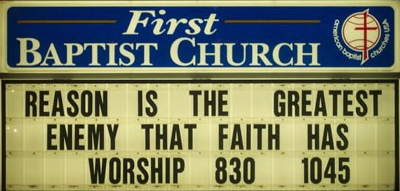
Two items today.
First item, the Mayor of Charlotte, NC, and current Transportation Secretary Nominee, Anthony Foxx declared last Thursday, May 2, a Day of Reason and a Day of Prayer.
Now comes the Fox News Crazy, Penny Nance, CEO of Concerned Women for America:
NANCE: Clearly, we need faith as a component, and its just silly to say otherwise. You know the Age of Enlightenment and Reason gave way to moral relativism. And moral relativism is what led us all the way down the dark path to the Holocaust…Dark periods of history is what we arrive at when we leave God out of the equation.
First, to iron man: nothing crazier than Thomas Aquinas here, declaring reason alone insufficient for human salvation. If we have to depend on our own lights, in other words, we’re going to blow it.
But iron manning this argument hides crucial insufficiencies. Moral relativism had nothing to do with the Holocaust, and there isn’t a slippery slope from reason to genocide. Sure, you can have reasons for genocide, but they’re bad reasons.
Second item. In another almost comical display of incompetence, Laurence A. Tisch Professor of History at Harvard University Niall Ferguson lays bare the shortcomings of the work of economist John Maynard Keynes. Here is an account.
Speaking at the Tenth Annual Altegris Conference in Carlsbad, Calif., in front of a group of more than 500 financial advisors and investors, Ferguson responded to a question about Keynes’ famous philosophy of self-interest versus the economic philosophy of Edmund Burke, who believed there was a social contract among the living, as well as the dead. Ferguson asked the audience how many children Keynes had. He explained that Keynes had none because he was a homosexual and was married to a ballerina, with whom he likely talked of “poetry” rather than procreated. The audience went quiet at the remark. Some attendees later said they found the remarks offensive.
That’s right: Keynes is wrong because he’s gay. I’d feel crazy had I used that argument as a fictional example of an ad hominem. But alas. I don’t go often enough to the well from which this sprung. Check out the link, turns out the “Keynes is gay” charge is quite the right wing meme.
Fun with Cartoons
Here’s a cartoon that expresses a sentiment I’ve heard a lot of lately (pulled it off of Reddit):

I’m sad that this needs commentary. Of the five or so things wrong with this, I think the worst is the implication that Christians, the religious majority in the United States, are oppressed, and homosexuals, a long-persecuted minority, are not.
Just little old me…
Dennis Prager’s post at NRO today is literally a series of conservative talking points on Islam and terrorism. All pretty much familiar fare, from identifying a persecution complex in their opponents (the irony!) to blaming the Left for encouraging them to their acts of violence, to just stopping short of calling Islam an ideology of indecency. But it’s with the last line of thought that Prager has an interesting line of argument. He holds that “Any religion or ideology that is above good and evil produces enormous evil”, and then he plays to make a contrast.
Unfortunately, most religious and secular ideologues find preoccupation with human decency boring. The greatest moral idea in history, ethical monotheism, doesn’t excite most people.
First, there are factual things in question. One is that most of the ideologies run on making the case that they are the last and best hope for decency. They wouldn’t be convincing otherwise. Liberalism is posited on the appeal of decency, by the way. Second, is ethical monotheism really “the greatest moral idea in history”? Solve the problem of evil before you say that, buddy. Moreover, I don’t even seen ‘ethical monotheism’ as really a moral idea — it’s more a meta-ethic, that God is the source of moral norms. That’s more a metaphysical idea. And aren’t there actual moral ideas that seem to be considerably more powerful than ‘ethical monotheism,’ anyhow? Deontology? Eudaimonistic ethics? Consequentialism? (It’s one thing you can say for Roger Scruton is that he’d never write anything this stupid. NRO and The American Spectator will miss his intellectual heft for sure.)
Finally, I suspect Prager’s got a very specific monotheism in mind when he says this… but, you know, his favorite ethical monotheism doesn’t have a particularly good track record, either.  Would we want Christianity judged by the decisions made by George W. Bush?
Factual questions aside, Prager’s case is interesting argumentative strategy. It’s a kind of downplayer, but on his own side. As if to say, “Well, nobody pays attention to little old me… I just try to do my best to be moral and upright and stuff…” The implicature of the speech act, of course, is to make the contrast — so as to say that popularity is a kind of negative authority of what’s right and true.
I’ve started calling strategies like this ‘persecution strategies,’ those that set up the dialectical board in a way that makes it inappropriate to overtly challenge the view. It runs: this view has had a long line of critics and rejections, and most folks think it’s crazy. But it hasn’t had a fair hearing. The strategy, then, is to identify most of the going criticisms of the view as mere expressions of the standard knee-jerk rejection of the view. Now, for sure, some views haven’t had a fair hearing, and it’s worth making the case they should be given it. But, as we’ve noted with the iron man, not all views need to be fully developed before we can see they are losers. And sometimes, it’s not worth our time and effort to do the work. Recently, in my survey of informal class, I’ve started calling this tactic the little view that could.
I don’t have evidence to back that up

The FBI and I don’t know who planted the bombs in Boston. Nor does Susan Collins, Senator from Maine. She, however, is willing to speculate (from Dave Weigel at Slate):
“Whenever we have an attack like this it’s difficult not to think that it’s somehow involved in Islamic extremism,†said Maine Sen. Susan Collins, until recently a top member of the Homeland Security committee and still a prime mover on security bills. “I don’t have evidence to back that up. That’s just based on previous attacks.â€
This is really dumb–“based on previous attacks” is evidence. Really bad evidence. Via Ballon Juice:
Maybe there ought to be some kind of history test for Senator.
El milagro de los milagros

A viewer of televangelist Pat Robertson’s 700 Club asked an obvious but important question about Miracles. Here it is (via Raw Story via Reddit):
On Monday’s episode of CBN’s The 700 Club, Robertson responded to a viewer who wanted to know why “amazing miracles (people raised from the dead, blind eyes open, lame people walking) happen with great frequency in places like Africa, and not here in the USA?â€
That is a good question. For one famous answer, see David Hume. For another answer, listen to Pat Robertson:
“People overseas didn’t go to Ivy League schools,†the TV preacher laughed. “We’re so sophisticated, we think we’ve got everything figured out. We know about evolution, we know about Darwin, we know about all these things that says God isn’t real.â€
“We have been inundated with skepticism and secularism,†he conintued. “And overseas, they’re simple, humble. You tell ‘em God loves ‘em and they say, ‘Okay, he loves me.’ You say God will do miracles and they say, ‘Okay, we believe him.’â€
“And that’s what God’s looking for. That’s why they have miracles.â€
One could argue the reverse ought to be the case: you need a background knowledge of the laws of nature in order to appreciate their violation. But what does he know, he didn’t live in Africa.
Don’t try this at home

Hunter, writing at the The Daily Kos makes a salient point about iron manning.  Speaking of Ralph Reed, invited just this Sunday to NBC’s Meet the Press to comment on the subject of gay marriage (he commented on the science!), he writes:
Anyway, this all leads to the biggest scientific question of all: Just how shamed and discredited do you have to be before Meet the Press and the Wall Street Journal will stop propping your sorry ass up as someone we all ought to be hearing from? The press is still looking for insights into the moral issues of our time from Ralph Effing Reed? Why?
Here’s a question, however. Philosophers have long distinguished, perhaps wrongly, between informed discussants and the rest of us.  They argue that since not everyone can pay attention to every single issue, at least in the way required to participate as a fully informed and capable interlocutor, they ought to be kept ignorant of those debates.  Don’t try this at home.
This raises for me a related question. Â In light of the fact that not everyone is paying attention, or paying very close attention, to our various Democratic debates, do we not therefore have a special obligation in their regard–a special obligation that we are on our best behavior? Â People do not pay close attention to debates over moral or scientific questions, so when you host them and invite them to join, you should perhaps think carefully about what you are going to expose people to.
Slippery coke
Check out this  Brian McFaden Comic (at the Daily Kos):*

Seems like your standard slippery slope argument to me (in addition to some poignant commentary on how wasteful this particular argument is). We’ve talked about this a lot here–here’s one by Scott from a few weeks ago. The question there was what distinguishes the slippery slope from the bumpy staircase.
I think of this whenever I walk through the outdoor area separating the building that houses my office from the rest of campus. It used to be that smokers (such as I once was) would occupy tables in this covered area. Now the area is off limits to smokers. I can see a smoker’s argument going something like this:
banning smoking outdoors in this one place will lead to banning smoking outdoors in another place, and eventually to the banning of smoking in all public places on campus.
This is certainly a slippery slope argument, but it doesn’t seem fallacious to me. There’s no significant conceptual distinction between the various moves. I imagine the justification is that the University has the right to regulate toxic chemicals on campus. They only do it piecemeal so as not to shock anyone. Full disclosure, I look forward to the universal ban.
Back to Bloomberg. Aside from the general question as to why start with giant soft drinks, this argument seems to be like the smoking argument. If city government has the power to regulate such things, then there is no conceptual distinction between various other food-related regulations. There seems in other words to be no relevant difference between the giant softdrink and the megabaconator. Banning the one is just like banning the other.
*an earlier version mistakenly attributed the comic to Tom Tomorrow.